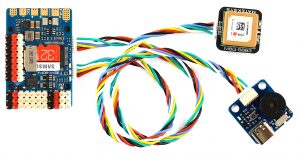
The F405-WING is now discontinued
Bad news! The Matek F405-WING is now discontinued. When vendors sell out of the current inventory, there will be no more. I know for a lot of folks they love this flight controller. It’s a workhorse. Time and time again they’ve been moved from one plane to another in my fleet and I’m sure in many other fleets. The F405-WING is just a well engineered piece of equipment. For many of us, it was the go-to flight controller. You knew how much it cost, how to solder it together, and how to hook up every UART port. Perhaps, it’s just being a creature of habit. But this was a flight controller people have an affinity towards. Perhaps it was the first flight controller they bought; or the one that was in their favorite INAV FPV plane. No issues, no drama, it just worked, first time, every time.
The F405-WING wasn’t perfect
I know the feeling. I bought the Matek F405-WING back in 2018; and I am still flying with it today. I mean, literally today. Which is part of the larger problem with the F405-WING being discontinued. The F405-WING is a mature flight controller. Yes, it will faithfully run every aspect of INAV you care about. No, the H743-Wing doesn’t run INAV any better than the F405-WING (for now). Two things I never liked about the F405-WING are:
- The Micro-USB would snap off. I had one break off when it was plugged into the computer. And though I can get to it with a FIDI adapter; INAV will forever be running INAV 2.4.1. What I have learned to do with the flight controlled with a vertical USB port is to glue it down to the board.
- The camera connection is 5V/Ground/Signal. Chances are likely this is how they are on your camera as well. It’s the same pin pattern for the VTX as well (VTX uses greater than 5V). There were a few flight controllers of it’s era that had this pin pattern. All the other pins on the flight controller are Ground/5V/Signal. What this means is if you don’t pay attention to the pin pattern you will fly your camera, VTX or both. Don’t ask me how I know.
The Matek F405-WSE

The F405-WSE is nearly an exact pinout of the discontinued F405-WING but it solves the two issues. First the USB connector is a USB-C connector (no longer Micro USB). Chances are likely if you bought a new Android tablet or smartphone it came with the same connector. The connector is on a satellite board which means you can bury your flight controller deeper into your plane and pull out the small board and connect it to your computer. The USB-C connector is far more robust than the one that came with the F405-WING.
The wiring for both VTX and Cam are now Ground/Voltage/Signal. The footprint on the F405-WSE is smaller than the F405-WING so it’s perfect for builds where space is the issue. And it comes with a buzzer that you can turn on and off with a switch.
Across the board the F405-WSE is a better flight controller in nearly every aspect. It has a higher rated current sensor; and it comes with the better barometer (DPS310). The MPU’s (processor) are identical in both flight controllers. So are the gyros and OSD. One won’t work any different than the other. They both have 6 UARTS. The F405-WSE outputs 8V instead of 9V for the VTX. This is closer to the actual optimum power of most VTXs. There is only one thing that makes the F405-WSE less than perfect.
The F405-WSE doesn’t run 7.2v servos
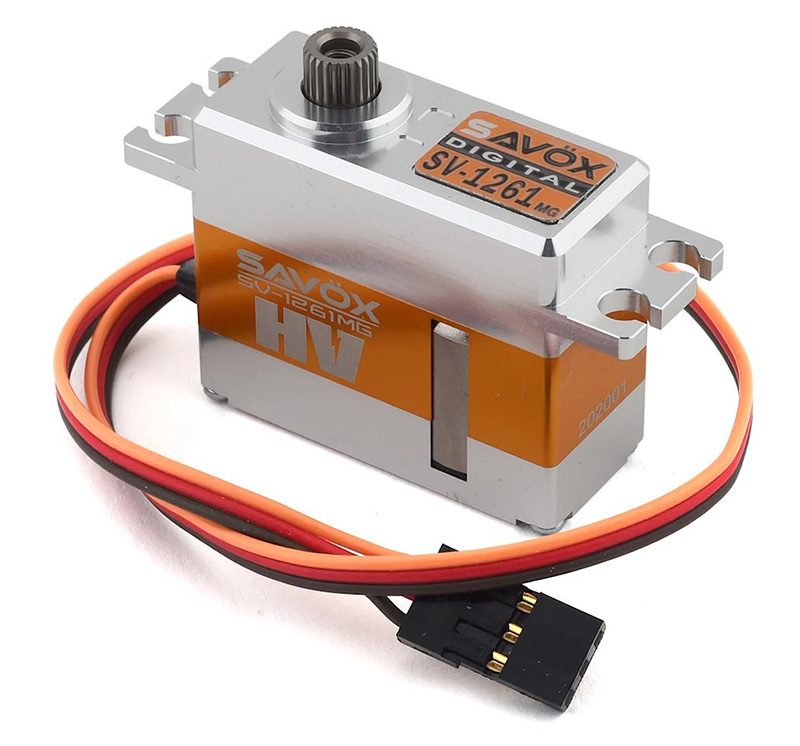
If you’re running TowerPro MG90S (hopefully you’re not, everyone deserves better than those), plastic gear, or most EMAX servos, this won’t make any difference to you. The vast majority of servos out there work on 5V and 6V. When you’re into 7.2v servos you are into high performance planes. The extra power gives the servo faster speed, quicker reactions, and more torque. For best performance, you should run the flight controller’s servo rail at the highest voltage that all servos can handle. Make sure to check the specifications of your servos. If you can’t find the voltage on the specs, best stick with 5v.
Thinking long term for INAV
Currently the INAV developers thinking about the future with H743 processors. This can allow for things like better filtering in the future. So, why bring it up? It’s time to read the writing on the wall. The H743 has a lot of processing overhead. In other words, INAV isn’t taxing the processor. People who develop code often look at more processing power and think of things to do with it. The point is, this is exactly what they are doing. It doesn’t matter if this project succeeds or not, the INAV developers are thinking of processing power.
The other big selling point is that the H743-Wing has twice as much flash memory than the F405-WING/WSE (2MB compared to 1MB). Lack of flash memory is a problem that ends support of a flight controller after a certain version. For example, INAV 2.6 is the last version to support F3 processors. In INAV 4.0 the F411 and F722 had some features turned off because of the lack of flash storage.
What the future of INAV potentially looks like
- Flight controllers with state of the art MCUs. New features that will only work with these flight controllers
- Non-state of the art flight controllers. The rest of INAV will work with all features except a few state of the art features
- Endangered species flight controllers. Most of the features of INAV will work fine, but certain less often used features won’t work. The F722 and F411 series fall into this category
- Unsupported Flight Controllers. A flight controller will work up to a certain version and then not work with newer INAV version. For example, the F3 doesn’t work with INAV 3.0 and INAV 4.0. Thus, it can’t benefit from the new and improved PID/FF controller of INAV 3.0 and INAV 4.0
Making the case for an H743-WING

If you’re into the large format heft of the discontinued F405-WING my suggestion is to buy the H743-WING V2. Yes, it’s more expensive. But, there are more features over the F405-WING. Such as: more UARTs, more ADCs, 8S support, can power 7.2v servos, has camera switching, and is more powerful, therefore more futureproof.
If you like the smaller flight controller size, the F765-WSE is the smaller version of the very popular F765-WING. The F765-WSE and H743-WING are fairly close in price, thus it comes down to preference. The F765-WSE has 2mb of flash memory, just like the H743-WING. But the H743-WING has twice the RAM and just over double the processing speed.
The boards are similar with the H series being the next generation of microcontrollers. When H743-WING first came out and for nearly a year INAV didn’t support it. Thus some people have selected the F765 as their new go-to microcontroller. Some people are weary of the H743-WING V2 due to the lack of support. As of right now, INAV completely supports the Matek H743. However, it does not support CANBUS.
Summing it up
INAV was at one point a smarter version of BetaFlight. Fixed-wing was an interesting addition to INAV. Around 2020 it became clear that fixed-wing was bringing people to INAV; and thus more effort was made to make INAV work better for planes. With INAV 4.0 the reality of fairly simple INAV tuning is here. It may not be perfect, but works great for a base tune.
This leads me to believe that in the future, INAV for developers will spend less time fixing problems, and more time spent enhancing the flying experience. To some extent, powerful processors will be more utilized in the future than they have been in the past. If you’re going to drop $50 to $60 for an F405-WING, spend the extra $20 to $30 and get something that has an F765 or H743 in it. It has twice as much flash memory, and that alone makes it worth the investment.
The F405-WING is discontinued. It’s time to move on.