

As part of tools, tips and tricks month on the INAV Fixed Wing Group Facebook group. We look at a subject that is sometimes asked. Should you replace your plastic geared servos? Servos make up a fraction for what your plane costs and using something better than the plastic servos will improve your plane’s performance without drastically changing the overall cost of the plane.
Why do PNP planes come with plastic geared servos?
The RC fixed wing hobby is heavily populated by line of sight pilots. Some LOS Pilots really aren’t builders. Some of these guys are fantastic at fixing planes that have crashed or need updating. But, they just don’t want to buy kits and worry about finding parts to assemble a plane. They prefer planes that come built in nice boxes. Something I call “Happy Meal Planes.” Some of the planes last a long time while others get destroyed on the maiden or soon after.

The disposable nature of this segment of the RC hobby, the light nature of their planes, and the fact that plane models get new updates every few years, creating end of life scenarios for parts, means that the plastic gear servos in these planes often don’t get to the point of failure.
INAV planes often see longer life cycles. Where a model can often last for many years of service, with occasional repairs and part updates. The extra electrical components added to INAV planes plus the often heavier batteries and the nearly constant use of servos in flight modes means that INAV servos are more prone to taking a beating. Thus, replacing the plastic servos that come with a plane is often a good thing to do while you add the INAV electronics to the plane. If at all possible, avoid the PNP planes, buy the kit version and do your research for viable parts.
Now that we’re starting to see more planes designed for FPV. One thing that stands out is that the smaller the plane gets, the more likely it will come as PNP only. This may be because the parts are smaller and more delicate. As we’ll see later on, sometimes these plastic servos are okay for these light-weight models.
What will better servos offer you?
The topic of servos isn’t always the most exciting for pilots to talk about. Usually the conversations come up when a servo dies and needs to be replaced. Up to this point a lot of pilots aren’t very concerned about servos. If they work, why worry about it?
If your plane is one you fly rarely, and you’re not really pushing it that hard, the plastic geared servos can last sometimes years before failing if they fail at all. There are also strata between plastic geared servos with some being able to take a bit of abuse while others fail at the first bad launch. Still, servos can change the flying dynamics of the plane, changing the feel and responsiveness of the plane.
Metal gear servos

Metal gear servos, as the name implies, replaces most if not all the plastic gears with metal gears. Making metal gears in China is fairly cheap and thus you’ll find metal geared servos that are often in the same price range as plastic geared servos. The stripping of plastic gears is one of the most common failures of a servo. The teeth on key gears often break off. Thus even cheap metal gear servos are a step up from their cheap plastic gear servo alternatives.
The TowerPro MG90S were the ‘go-to’ metal gear servo for a lot of pilots prior to 2020. Bang for the buck they couldn’t be beat. They weren’t good per se, just okay. But, these servos were made in different factories and after a while people started to notice the quality went downhill. These servos, once a staple on Banggood, aren’t offered by Banggood any longer. TowerPro now suffers from very cheap knockoffs being sold on eBay and Amazon where they may be different from each other, order to order.
The largest problem people had with the TowerPro servos was that they centred poorly. This leads to control surface issues. Thus, before buying a 10 pieces MG90S servos lot for under $40. Consider spending a bit more for a name brand servo.
The metal used for the gears can be aluminium, steel, titanium, or karbonite. Steel adds weight, and titanium and karbonite adds to the price tag. The type of metal used isn’t always listed; and thus it’s either steel or aluminium. Aluminium tends to be more expensive than steel. The bottom line is that regardless of metal type, metal gear servos will most likely last longer than plastic gear servos.
What you’re flying with

In the hierarchy of servos, the majority of what we fly with are on the bottom rung of servo technology. Even some of the step-up servos we’ll cover later on are on the bottom rung of technology. Yet, don’t get too concerned. The peak of the servo pyramid are servos that as of now are too large for most of the planes you fly. Due to the light nature of the planes we fly we rarely go outside the realm of 17g servos. Thus, for now, the smaller sizes of the servos we use prevents us from putting in high end brushless servos.
Brushed motors have been around for many decades. By now they have figured out how to maximize the quality of these motors while keeping the price low. Regardless, brushed motors degenerate over time with use. If you ever get to a point where one servo on your plane is old and starts to give out, instead of just replacing it, you should replace all your servos. By the way, that’s quite a feat if you can keep a plane flying long enough to wear out the brushes in the servos. There are certainly quality differences between the low end plastic geared servos and the most expensive end of the brushed servo market. We’ll look at some higher end servos in the DC Servo segment later on.
Coreless servos

Coreless servos feature much lighter motors. This can mean they offer greater speed and torque. They are most often used in RC helicopters, RC cars and higher end planes and gliders. Though they are fairly complex to make they still use brushes. They tend to last longer than the DC servos we use, their technology may be eclipsed by Brushless motors. On the left is a Hitec HS-55+. This is an 8g coreless servos, the same size as an EMAX ES08MD II. But at twice the price. This is an example of a servo built for lightness, featuring nylon gears, and only a speed of 0.14 seconds/60 degrees and a torque of 1.6 kgf-cm, at 6V.
Brushless motor servos
You are familiar with brushless motors, they are the primary motor(s) that power your plane. This is the up and coming technology for servos. For now they are far too large for our needs but over time I am expecting that to change. As you can see from the miniaturization of quads, brushless motors are getting smaller and smaller. To get to the point of 3g-17g servos means we have a ways to go with extremely thin wire used for the windings of the motors.

Quite frankly, the RC market isn’t large enough to create enough demand for small brushless servos. Yet there will be industrial, consumer and medical applications where micro servos would be very costly to replace. The demand for long life means that these brushless motors with their Hall effect sensors and complex electronics would be justified. This may happen in a few years or another decade, but it will most likely happen. As more get manufactured, the price goes down to the point where they would be within the budget of most RC pilots.
What these servos have going for them is that they can be used nearly constantly. They have long lifespans and would fail very rarely. INAV stabilization works on micro-corrections. If you’re constantly using a brushed servo it will wear out faster. This concern would be eliminated with brushless servos. It could help aid in better stabilization though it wouldn’t take away the effects of wind or turbulence completely. As INAV evolves and our flight controllers evolve it would be fantastic if higher end servos could further enhance flight performance.
Digital and analog servos
We’ve covered the motors in the servos, now we’ll cover how the servos receive information. Digital servos can be found with all three motor types. As opposed to using an analog signal which is the older technology digital servos receive its data digitally. Thus, they are more precise and the way they move just feels different.. They are great for performance based aircraft. The feel of digital servos is smoother and more responsive than analog servos. You can most especially tell the difference in Acro and Manual flight modes.
If you would like to use their higher speed settings of digital servos you can check this box.
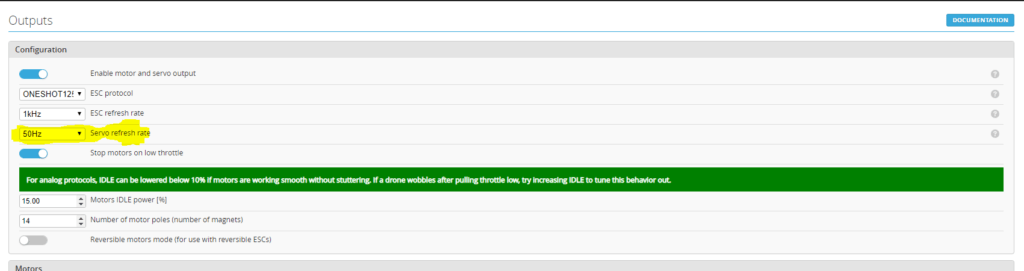
This is in the “Outputs” tab. You can try 330Hz. If the servos don’t move the signal they won’t be able to communicate at that high rate of speed. You can try 160hz next. Keep working it until the servos communicate. The problem is that not all servo manufactures publish their optimum signal settings.
If you start to notice as you switch over to digital servos or better analog servos that the plane feels twitchy and you don’t care for this especially in the Acro and Manual flight modes. It’s highly advised that you set your control surfaces so that travel is correct. Darren Lines has a great video on adjusting your control surfaces. If you do this extra work you may really enjoy the flight performance of digital servos.
Servo power ranges
4.8-5.0 volts
This is the standard old time voltage range for RC planes. By default, most flight controllers have 5V BEC outputs. Some people don’t realize that they are not only capable of more power but your servos will often handle it. If you learn nothing else from this article, check out and see if your flight controller and servos will work on 6 volts or greater. There is a relationship between electrical power, speed and torque of a servo. As we’ll see later on, going from 5v to 7.4volts may mean the servo can handle an additional 1KG of torque before stalling. This is something to keep in mind for your plane’s elevators where one servo has to overcome sometimes many Gs of force to maintain or regain level flight.
6.0 Volt Servos
Even the cheap SG90 plastic gear servo that costs less per pound than noodles use 6.0 volts. As mentioned before, on most flight controllers including the Matek F411-WSE have 6.0 volt outputs; though, the default is 5.0 volt. While you have your flight controller laid out on the table, as you begin to solder, take a moment and bridge the 6.0 volt jumper and enjoy a bit more speed and torque.

7.2 Volt Servos

There are 7.2 volt digital micro servos that aren’t terribly expensive. Still, check your flight controller to see if there is a 7.2 volt output option. The Matek F405-Wing has a 7.2 volt option. But, be careful, if your servos work at 6 volts max and you select 7.2 volts you can fry your servos, potentially in flight.
BTW, this was driving me insane. Notice the flight controller says 7.2 Volts? The servos are listed at 7.4 Volts. This is like listing a 4.8V servo as 5 Volts.
8.4 Volt Servos
These servos tend to be larger than what we use. These servos can be standard DC brushed motor servos and thus they can be quite reasonably priced. They are often low cost alternatives for coreless or brushless servos for RC cars. I’ve only have seen one flight controller with an 8.4 volt output option, the FrSky F765 Pilot. Servos that use 8.4 volts tend to draw far more power than you may expect. Though the full sized Drak may not spell out brushless 8.4 volt servos, why not dream big?
Straight talk about servos
It just feels counterproductive to start ripping out servos from a new PNP plane. But some planes demand it. Such as the Volantex Ranger 1600, which only comes as PNP. Instead of throwing them away keep them and use to test with. If you’re part of a flying club someone is always in need of a spare servo. Or you can buy a Bixler or Skysurfer kit for line of sight flying and use it for that. When you get into LOS flying you’ll be landing in trees and crashing more often, a good opportunity to break servos. It’s always nice to have a supply laying around.
When should you keep plastic gear servos and when should you get better servos?
Keep your plastic gear servos if
- The plane is very light in weight.
- You’re not certain you’ll be keeping the plane
- You’ll be rebuilding the plane after you get the feel of it.
- You won’t fly the plane often
Replace your plastic gear servos if
- The plane will be built heavy
- You’ll be doing long range FPV
- You want peace of mind.
- You’ll be flying the plane a lot
- You’ll be flying aggressively, often
Examples
Up to 800mm
These are small planes often built fairly light. With planes like the Mini AR Wing or ZOHD Dart 250G, the servos should be fine for a while. They are typically light planes where flat out replacing servos may not make a lot of sense. Perhaps you can fly the plane with it for a month or two to get the feeling of the plane and decide if you want to replace the servos? The Wing Wing Z84 also falls in this zone; though a tad bit larger than 800mm. If this will be a plane you don’t fly that often, just about any servo will be okay. If it’s a plane you end up flying quite a bit and have developed an affinity toward a couple nice EMAX analog metal gear servos won’t set you back more than $20.
800mm and larger
A recent survey of the INAV Fixed Wing Group on Facebook showed that the average sized plane that people flew was 1000mm. These tend to be a bit heavier planes where people try to put in larger batteries to boost flight times and flying distances. Even the original AR Wing can fly in the high 500g to over 1 kilo. With 700g to 800g being more of the average. When you get into the zone where you’re flying with heavier packs, and perhaps pushing the plane’s All Up Weight a bit; you are certainly advised to swap out your plastic gear servos.
Servo comparison
EMAX ES08MA II – 12g Sub-micro metal gear, analog servo

This is my new go-to servo for new builds. 12g and 9g servos are the same physical size. The weight changes because of the gear material. Though this servo is analog, these little guys are fantastic! The specs on this servo are IDENTICAL to the specs of the digital version. The two versions are identical except for how the signal is received. The digital version should feel a bit more precise when flying in Acro and Manual modes.
This is what I consider to be a baseline INAV servo. Yes, it’s a DC motor and it’s analog. They are fast and fly very smooth. I wouldn’t think twice to use them on a 1.4 kilo plane for long range FPV.
| 4.8V | 6V | |
| Speed | 0.12 sec/60 degrees | 0.10 sec/60 degrees |
| Torque | 1.6 kgf-cm | 2.0 kgf-cm |
By changing from default 5V to 6V; the servos will run 16.7% faster and provide 25% more torque. Most of the Matek flight controllers have a 6V option, though it’s not default.
JX Servo PDI-HV0903MG – 9.4g High torque digital servo

The specs are roughly the same as the EMAX ES08MA II at 6volts. Where it gets interesting is when it gets turned up to 7.4 volts. Then the servo gets 22% faster. The stall torque increases by 30%. The stall torque of the EMAX servos at 4.8 volt to this servo at 7.4v increases 1 full KG from 1.6 to 2.6kg. That’s a 62.5% increase in the stall torque and a 42% increase in speed. Keep in mind that this servo isn’t the over $100 brushless servos. It’s a $17 servo. Your entire plane could be easily outfitted with these servos for the cost of one high-end brushless servo.
| 6V | 7.4V | |
| Speed | 0.09 sec/60 degrees | 0.07 sec/60 degrees |
| Torque | 2.0 kgf-cm | 2.6 kgf-cm |
ICE 14g TWS1514D Digital Ball Bearing Metal Gear Servo

Weight: 14g / 16g with wire
Dimension: 22.8 x 12 x 31 mm
Stall torque: 3.1kg/cm (5.0v); 3.5kg/cm (6.0v)
Operating speed: 0.13sec/60degree (5.0v);0.08sec/60degree (6.0v)
Operating voltage: 5.0~6.6v
Gear Type: Metal gear
Bearing: Double ball bearing
Servo case: Middle with alloy case
Temperature range: 0- 55deg
This servo was a suggestion from a well known Long Range FPV member in the INAV Fixed Wing Group. The specs look fantastic. Perhaps this would be a good servo for a larger custom foam flying wing. The motor type isn’t listed thus it’s assumed these are DC servos with larger motors. These servos fall in the price/performance range. They cost nearly twice as much as the EMAX servos, but nearly half as much as the KST servos listed next. Comes in an alloy case for heat dissipation.
KST DS215MG V3 Micro Digital Metal Gear Servo

Features:
- Micro size aluminum case
- Full metal gears
- Dual ball bearings
- HV compatible
- Lightning fast
- Coreless motor
Specifications:
Operating Voltage: 6-7.4V
Size: 23x12x27.5mm
Torque: 3.10kg.cm @ 6.0V; 3.70kg.cm @ 7.4V
Speed: 0.06sec/60° @ 6.0V; 0.05sec/60° @ 7.4V
Weight: 20g
Working Frequency: 1520us/333Hz, 800us – 2200us
Motor: Coreless
Ball Bearing: 2BB
Everything is relative these days. The cost of these servos is around the price you would to pay for a ‘decent’ servo for your nitro plane 30 years ago. To outfit four servos in your plane will cost you $150. These are coreless servos which on the hierarchy of servos is the middle rung. Still not ‘brushless’ but boasting of the best speed and torque of all servos listed this far. This would be a great servo if you’re upgrading your EDF. If your flying style is to push a plane to the point of imploding in flight these are certainly the servos for you. If you’re a relaxed FPV pilot of flies high and rarely turns, save your money.
FrSky BLS5405H

Just for comparison, here’s a standard size brushless servo, that is digital. It comes in at 80g, which could be around, if not more than the weight of your plane’s motor. Instead of maxing out at 2.6kg it maxes out at 55KG (21 times more stall torque). At 8.4 volts this will stall at over 9 amps.
This servo also has built in telemetry which can feed back to the flight controller or or F.Port based RX using F.Port 2.0. Yes, this may be out of the realm for most INAV hobbyists but this is a servo built for the future. The aluminium case further dispenses heat which makes it ideal for planes flown in warm environments like a desert. Planes like these are often flown in the desert. They are large, heavy, and very expensive (up to $15,000). They make quick, tight turns putting maximum G-Force on the servos.

This FrSky servo is new and not readily available, but you can expect to pay well over $100 each for them when available. This is a high end servo in the top tier of the servo technology. Hopefully, these servos will come to smaller, lighter planes we fly.
Again, the large selling point is that the brushless servos can take a lot of constant use which could help with flight stability.
Why don’t we rate servos?
In theory we could ask the INAV Fixed Wing Group to weigh in on suitable tests for servos, such as attaching fishing weights to them and putting them to the test for an extended period of time such as a few weeks. It’s easy enough to buy 10 of the most common servos in the market and do this. But, that’s a sample of one. I would want to have samples of 20 from sources all over the world. And then every few years I would want to run the tests again in case something changes such as sourcing new components for the servos. This gets to be quite expensive and time consuming.
What complicates this even more is that there are cheap Chinese knockoffs of name brand servos that sometime show up in Amazon, AliExpress and eBay. They are by far inferior to what you expect. From the casual testing that I’ve seen the reliable brands tend to list specs that they can achieve. When you’re buying servos you should get them from vendors you trust. Chances are very likely that you will find great consistency over time. The name brand servos are something you can rely on which is better than bulk priced servos that are sometimes fine, often times not.
Summing it all up
There are more than enough compelling servos for under $20. And though our domain of planes can’t take advantage of brushless servos at this time, it’s not like people are outright demanding them. Keep in mind that we’re playing with relatively small and lightweight aircraft. The point is that you may be able to save money if you stick with plastic servos. But, for a small investment you can change the characteristics of how your aircraft flies for the better, and prevent servo failures. The performance, the feel of the plane, and your peace of mind are all worth it.
How to tell if you’re getting genuine servos
Counterfieting is a problem in our hobby. Since the first version of this article people have mentioned that they’ve learned the hard way about cheap servos. They are willing to pay a bit more for a good servo, but worry about getting fakes. So, this document has been ammended to discuss working around the conterfiet market.
The single best thing you can do is when you find a servo you’re intersted, go to the company’s website. Find if they list their vendors. Matek does, EMAX doesn’t. The second best thing to do is to buy your merchandise from a vendor you trust. Right off the bat I do not trust eBay, Amazon and AliExpress when it comes to servos. Maybe you’ll get genuiine merchandise, maybe you won’t. I need better than that. I get my EMAX servos from places like Race Day Quads GetFPV and ReadyMade RC. Aloft Hobbies, Altitude hobbies and even EMAX-USA sells the servos as well. And yes, I’d get it from Banggood if the price seems reasonable. My motto is “Trust, but verify.”
There is a scratch off sticker on the bottom of the box of EMAX servos I bought.

It suggests visiting YinYanmodel.com which takes you to a website that runs flash. I haven’t used Flash since my Windows XP days. Instead, I found a link on EMAX’s main website.

I put in the code and got this message.

As for JX servos they are sold at Banggood. I am currently in contact with the company trying to figure out how to find other authorized vendors. JX is short for Shantou JiXian Electronic Technology Co., Ltd. It’s not well known to end-users but runs its own factory and does $30 million in sales a year. The products are used in control valves, smart locks, consumer electronics, automotive and medical devices. I’ve used their servos and really like them. Others have also given JX servos rave reviews.

