
To start off this article, I wanted to own up to the fact that I am fan of the Bixler 2 for a few reasons. It’s cheap as chips, it’s easy to modify and it flies great. Thus, you would expect me to simply continue on the fanboy mentality with the Bixler 3. But not exactly, the Bixler 3 is a different plane. Some things are better, some things are worse. What I will say is that what I hope to give you is a realistic assessment of what it’s like to own one, instead of hype. I also will go over all the parts that were included on my build and to simply state that if you plan to take this plan out any distance, don’t rely on the PNP version.
Larger planes fly differently than smaller planes. Smaller planes are a bit more chaotic in the air. Large planes tend to be smoother flying experiences that are all around refined. The problem with larger planes is the supersized price tag. The Bixler 3 is an anomaly, it’s a larger plane flying experience with the smaller plane price tag. Yes, there are stellar pretty planes for a lot more money. But, once you strap on the goggles does it really matter? I’m into taking the plane for a ride.
Aside from selling the Bixler line of planes cheap, Hobby King also has spare parts for sale. That and the fact that they don’t change the model every couple of years like Horizon Hobby tends to do means that you can keep your Bixler going for a very long time.
The Bixler 3 as a platform
This article won’t cover the Bixler 3 as a PNP parkflyer. I can tell you I’ve set it up and flown the Bixler 3 PNP. It’s very nice for a simple LOS plane. Yet, I wouldn’t load it up with batteries, FPV gear and send it out a distance with the servos and motor that comes with the plane. Therefore, for FPV I only suggest the kit version of the Bixler 3. The kit version goes in and out of stock all the time so put your name on the waiting list if you would like one.
My tendency is to think of planes as FPV platforms in their most basic form. Does it fly well? Does it hold FPV gear? Does it require many mods and workarounds? And when you add up all the costs, the extra work and potential headaches, is it worth it?
The Bixler 3 is worth it. I’d say the largest disadvantage it has is that you cannot go crazy with large battery packs and thus this plane will never really be a long range FPV platform plane. We did a survey in the INAV Fixed Wing Group. Long Range FPV flights aren’t as common as you’d think. Most flights are less than half an hour. The Bixler 3 is a perfect platform for medium range FPV flights with shorter duration. With under 20 minute durations.
The other disadvantage is that the rear of the fuselage is solid foam. This is a good thing in terms of structural support. The tail end of the fuselage doesn’t bow like the Bixler 2. But it does make getting wires to the back a bit more difficult. I used a hot nail to trench thin channels in the foam to run wires.
My parts list
The powertrain
It’s best to think about the motor, ESC and prop as a unit, because they all relate to each other. What I’ve selected for this plane is a very good upper-midline powertrain. The amount of thrust it generates gives it a decent angle of attack that doesn’t seem to wane after 5 seconds. This powertrain combination for this plane just seems to work. I am very happy with it’s performance.
Motor- EMAX GT2215/09- 1180KV– There is a very specific reason why I ordered this motor, which for the life of me I can’t remember other than it was on sale. I posted about this motor in the INAV Fixed Wing Group and a lot of people wrote back saying that they had this motor as well, and liked it. It’s largest downside is that it only handles 2S & 3S. Others said that they have run it on 4S, though it’s not suggested. Since I am trying to use parts that I have on hand instead of buying new parts this is the motor I went with. If I was buying a motor for this plane it would be the Sunnysky X2216 V3 (Blue) 1250KV. I would also use at least a 40A ESC. The EMAX motor has similar specs to the Sunnysky. It’s just that the motor cuts out a little under 30a and the SunnySky goes up to over 40amps. With that you can pull in a lot more thrust if you need it. I just never really need it.
I am more prone these days to removing lackluster motors from planes and replacing them with better motors. Though I have A Sunnysky motor ready to go, all I can say is that the EMAX motor meets my expectations and there is no reason to switch.
Motor Mount– In order to get the motor up high enough to fire off a 9×6 prop it had to be raised. This is what I used. It’s from SmallParts CNC. You can write to the owner and ask him if he plans on making any more. If not, you can download a Bixler 2 (or 3, they are the same size) motor mount from Thingiverse. Just be certain to use 100% infill or the mount will break under load.
ESC HolyBro Tekko 35A– It’s a premium ESC but so far it’s smooth as silk. I haven’t bothered to hook it up to a spare TX yet to read telemetry. It’s not getting pushed hard with a motor that doesn’t consume more than 29A.
The thing I can say about ESCs for fixed wing is that most of us aren’t as hard on them as quad pilots are. Thus if you do a good job of soldering the leads on the ESC, you use the correct ESC for your powertrain application, and you balance the prop then just about any BLHeli ESC will work well.


APC 9×6 Prop– Out of all the mid-fuselage pusher planes I’ve ever owned I’ve only had to replace one prop because it flew off. Thus, get a good prop that you trust because you’ll be flying it for quite some time. Also balance it before you install it. It takes around 10 minutes to balance a prop, but it’s so worth it! A prop that is out of balance can lead to gyro issues on your plane and potentially can kill your ESC. There are APC knockoffs from Gemfan which are also good, but the genuine APC prop is a step above and not that much more expensive.
I used to add tape to the lighter prop to balance it. Now I sand the heavier prop on the training edge.
Servos
Once again, I am using an EMAX product, the ES08MD-II metal gear digital servos. When it comes to servos, sometimes it’s better to pay more than you want to than less than you should have. After taking a deep dive into servos for INAV planes I can summarize things by saying that the servos we use for foam RC planes are brushed motor servos which are fine for our needs. People often use servos like the TowerPro MG90S which can often be found for under $3 and think that since they are using a metal gear servo they are fine. They look at spending $7 more a servo as excessive. What do you get for the money? You will get servos that center well and thus prevent the plane from flying wonky. You will get servos that can handle a heavier load and you will get servos that will make this plane a lot more enjoyable to fly. There are analog versions of this servo, and other well respected servos from JX servos. Thus you do have options. For just one plane, put on nicer servos and see for yourself.
.
Flight Controller
My flight controller of choice for this plane is a bit overkill. I would suggest the Matek F405-Wing, if you can still find it.
Now, let’s follow the logic of my decision. I’m not a fan of the Matek F405-WSE. I mean, when push comes to shove, it’s okay, I guess. I prefer wing boards. The F405-Wing is an older board, from back in 2018. The fact that I’m still flying with them today, from back when I bought one when it first came out means that flight controllers can be around a long time. If you think about it, they really don’t get used all that much. Perhaps 10 hours of use a year if the plane is flown a lot. Thus, unless there is a major accident, my F405-Wing can last a few years longer. Yet, at some point there will come a day when the INAV developers have to cut features on the F405-Wing board with future updates. 1MB of flash memory is fine for now. But, will it always be fine? The reason I went for the H743-Wing is because it has 2mb of flash memory and the processor is newer technology. At some point I may get a cool new plane, and I may move this H743-Wing to that plane.


Camera
I used a Foxeer Falkor V1 which I had used on another project a while back. So, the question is, why don’t I put on a Falkor 3 or something modern? After all, I went first class on everything else? For this application, the Falkor is more than fine. It’s a good camera, good lens. Quad pilots need the latest and greatest. Fixed wing pilots, not so much.
VTX

The Eachine TX805 is my down and dirty VTX. It only puts out around 600mW (not 800 like they claim). Yet, these things are cheap and work great. I only use VCC, ground, video and Smart Audio.

VTX Antenna
Foxeer Lollipop 3
I really like these antennas, and once again, it was what I had laying around. These are my cheap “Go To” antennas.

Receiver (RX)

I fly with FrSky. The FrSky R9-Mini was an antenna I had laying around. Since the flight controller wasn’t an F4 based one I didn’t need the inverted S.Port and thus just about any 900mhz receiver from FrSky would have worked. This receiver is attached to my vertical stabilizer on my tail. It works great, and I have zero complaints.
Flaps?
The Bixler 3 does suffer a bit from ground effect, and thus you’ll need more space to land. The Bixler 3 may also benefit from flaps for helping to find thermals. Flaps could help slow the plane down and keep it in the thermal. Flaps would be useful for thermals, takeoff and landings. It’s just a couple more servos and some extra wiring, and a little extra time with INAV.
I have flaps on some other planes and found that I really don’t use them as much as I thought I would. The flaps would add weights and a bit of complexity. At some point I may think they are worthwhile and may add them. But to start off, I didn’t put flaps on the Bixler 3.
Electronics Placement
The key to my Bixler builds is to avoid putting electronics on the wings. Thus the camera and VTX went onto the canopy. I used a car stereo electronics clip so that I could unhook 6 wires instantly. I also gave an abundance of cable so that I could take the canopy off and set it to the side to change out the batteries. The GPS went to the middle/ back fuselage behind the prop and the RX antenna went onto the tail. I had to do a bit of foam cutting to make it all fit. But, it worked out fine.
Paint and lamination

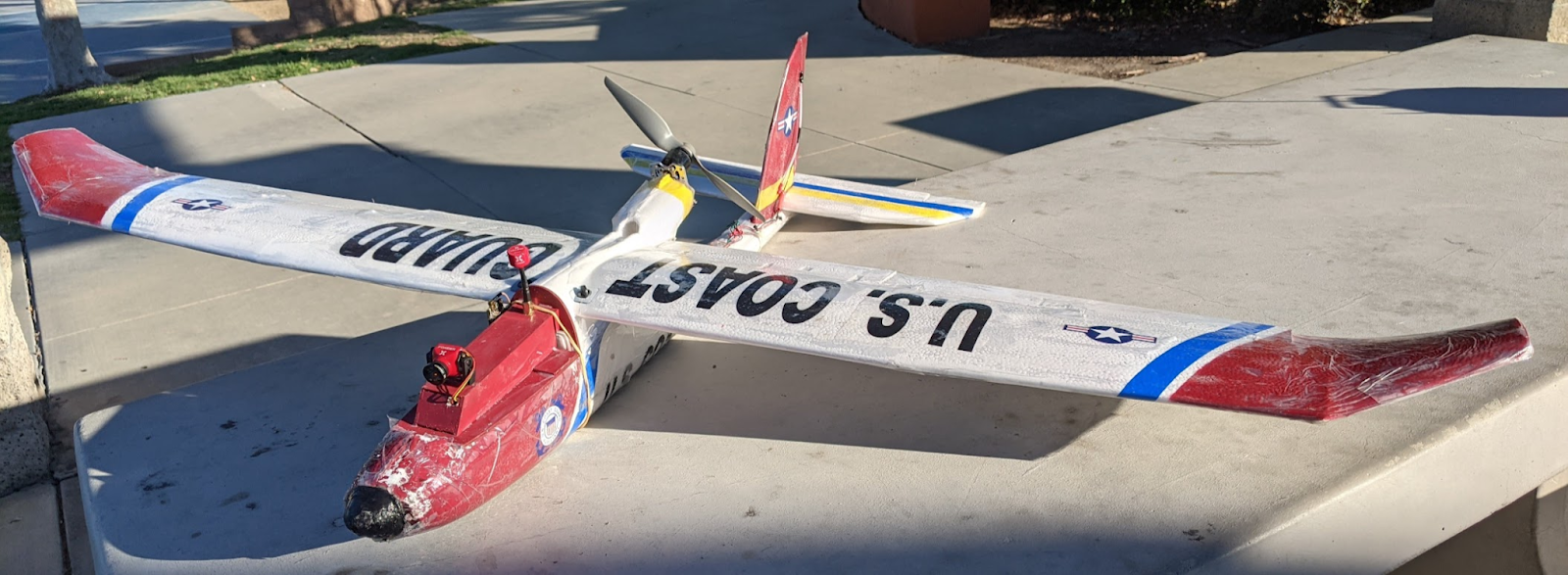
The Bixler 3 looks nothing like the United States Coast Guard’s C-130 Hercules. But, I wanted to emulate the color scheme. I used 3 mil of lamination to cover it.
The Autotune process
The first flight was in manual and a bit chaotic because it needed around 80g of noseweight which it didn’t have. When this was fixed the plane tended to mostly behave in manual. The rudder was slightly off and thus the plane liked to fly around in circles. When I fixed this, the plane was flying much better. There is no autolevel or autotrim on this build. My theory was to fly the plane straight and level in manual and let go of the sticks. If it turned, or fell, I would land it, fix it and send it back up again. Over a couple of flights I probably did this around three or four times. When the kinks were worked out I put it into Acro mode, turned on autotune and finished the process. I am flying with stabilized yaw with the plane and it flies great.
Flight performance
The hand launches with this plane are epic. I am used to the Bixler 2 where the hand launches can dip a bit. I do have to mention that this build is without landing gear thus each launch is a hand launch. The Bixler 3 hand launches are smooth and controlled, nearly like what you would expect a scale launch to be. This plane also has a very smooth climb angle of attack where it doesn’t seem to nose down with battery sag after five or six seconds.
Once in the air and at its desired altitude the pros and cons of the plane are evident. They are:
Pros
Elegant– The term “flies on rails” tends to get thrown around a lot to describe planes. To me, that means it can fly straight and level fairly well. My Bixler 3 does that as well, but when you turn you really start to feel how the plane is very well behaved. It may be the digital metal gear servos really kicking in, the turns are silky smooth. The turns feel like you meant to make them. Sometimes when flying smaller models like the Bixler 1 or 2 the turns feel a bit forced.
All the best qualities of the Bixler 2 seem to be in the Bixler 3. Smooth, well, behaved, but the Bixler 3 does it with style and grace. Thus it’s elegant. This would make a very nice platform for filming video.
Handles wind well- The tends to not get kicked around by the wind as much as the other two versions of the Bixlers. The Bixler 3 tends to be a very smooth flying experience.
Gains altitude effortlessly– This was something I’ve noticed with the Bixler 2. The plane can fly level and pick up 100 meters in altitude without you really noticing. I am used to flying wings where altitude requires energy consumption on some level. There has to be a situational awareness of altitude when you fly the Bixler 2 or 3. The Bixler 3 seems be even smoother when it’s going up. I think it has to do with the long wings, and relatively light fuselage. The Bixler 3 can just gain altitude without a lot of energy.
Explore the sky-Like with the Bixler 2, there is a sense of being part of the sky and flying through different environments. I really don’t feel this with a flying wing, per se. The Bixler 3 certainly puts a smile on my face.
Cons
Pushes down with throttle- This tends to be the problem with planes like the Bixlers (mid fuselage pusher) where the motor mount is above the thrust angle. It just takes a little getting used to. Yet, the takeoffs with the Bixler 3 are much better than with the Bixler 2s
Tip stall-This was a problem brought up by Andrew Newton. What I experience is that when a less than graceful turn occurs, or when it hits an updraft the plane does a tip stall or can go into a full stall. It’s like one moment things are fine, the next moment the plane isn’t moving.
What I believe the issue may be is with the overall weight of the plane. When the first Multiplex Easystar came out, the Germans had lightening in a bottle. But, these planes were just slightly under 1400mm. The Bixler 3 is 1550mm. It appears that the extra 150mm (six inches) went to the straight, flat segment of the main wing. The upswept dihyderal is less pronounced on the Bixler 3 than on the Bixler 2. The upswept dihyderal on the Bixler 1 and 2 did more to self-right the plane which was a throwback to the EasyStar trainer plane design.
My theory is that the Bixler 3 is simply too light. Perhaps the landing gear provides enough drag whereby you have to keep your speed up. When it’s a glider the drag is reduced and thus it can fly fairly slow, perhaps too slow for its own good? I will experiment some more with ballast.
The verdict
I am still playing with the setup of the Bixler 3. I will be adding ballast to see if this improves flight performance and reduces tip stalls. I also am working on some other minor issues. Overall, I do love this plane. It’s one I look forward to launching. It’s really a pleasure to fly and seems very stress-free. If you love relaxed FPV, you’ll love it. I am also very happy with the powertrain and servo combination.
A while back I picked up a used Volantex Ranger 1600 which has a 50mm larger wingspan. It took me a while to repair it and get it ready, but it’s now good to go. This will be the end of the line. Someone in my flying club has the Stratosurfer but needs a tail. When parts come available I could get that going for him. The AtomRC Seal is something I won’t venture into for a variety of reasons. And yes there are Multiplex Easy Star planes and a host of other mid fuselage pushers. But, no, I’m good.
With some more experience with the Ranger 1600 I can relate how the Bixler line compares to it. So, stay tuned!

